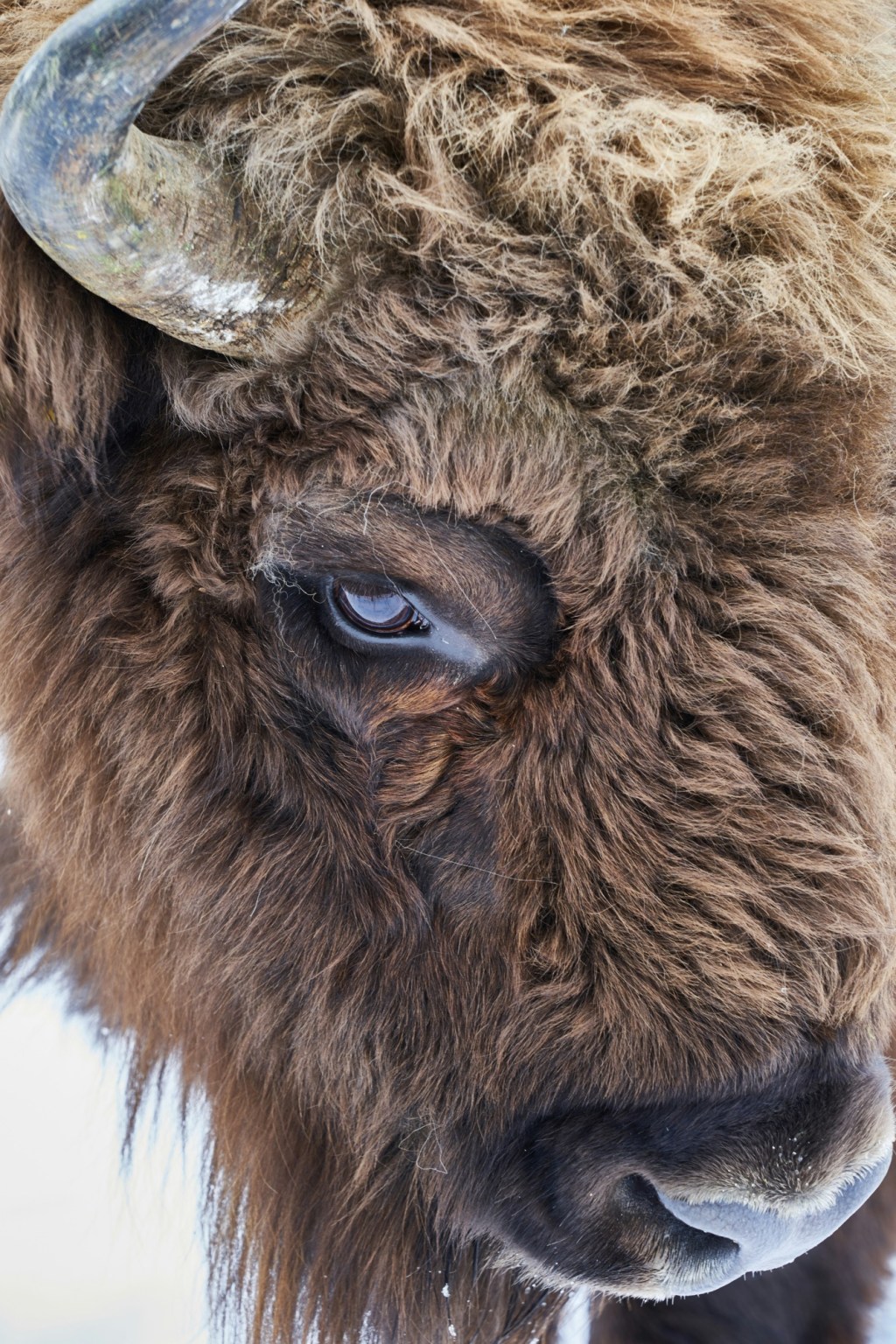
and its effect on Native American tribes.
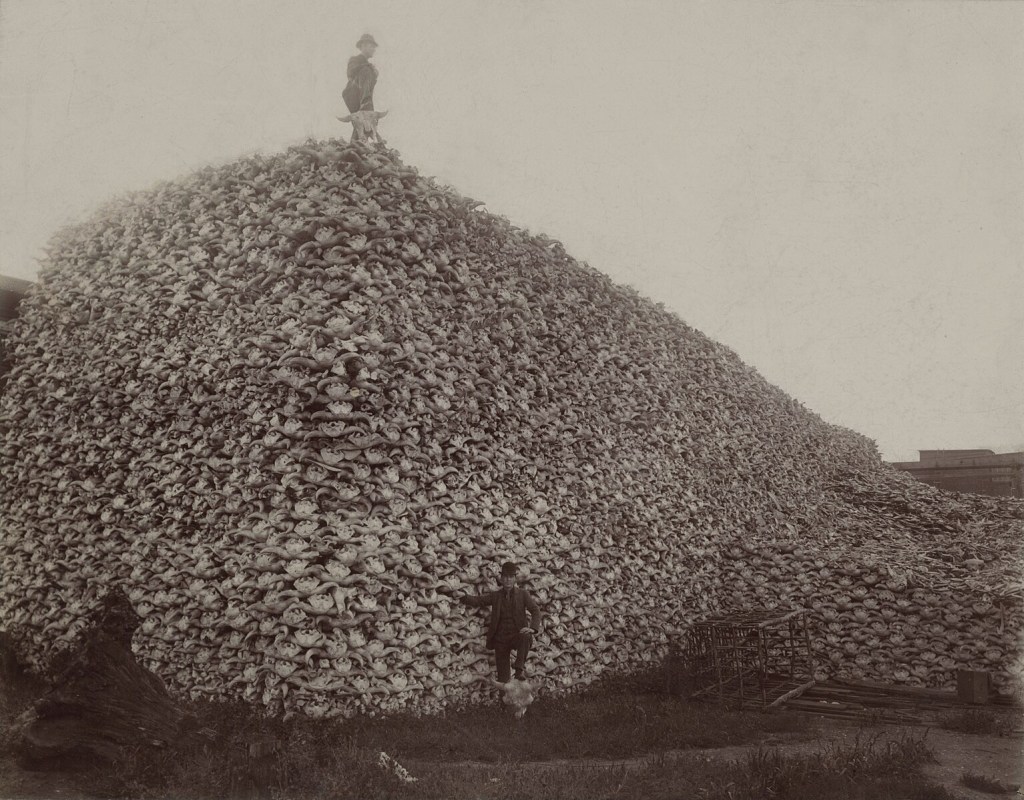
I’m writing this after reading a document titled “The Slaughter of the Bison and the Reversal of Fortunes on the Great Plains.” Published in August 2022 by Donn. L. Feir, Rob Gillezeau, and Maggie E.C. Jones on nber.org, this document sheds light on the atrocities committed against the bison and their lasting impacts on Native American tribes that heavily relied on these herds. I highly recommend reading it yourself by following the link provided above or in my sources down below.
This is a summary copied and pasted directly from the document:
“In the late nineteenth century, the North American bison was brought to the brink of extinction in just over a decade. We demonstrate that the loss of the bison had immediate, negative consequences for the Native Americans who relied on them and ultimately resulted in a permanent reversal of fortunes. Once amongst the tallest people in the world, the generations of bison-reliant people born after the slaughter lost their entire height advantage. By the early twentieth century, child mortality was 16 percentage points higher and the probability of reporting an occupation 29.7 percentage points lower in bison nations compared to nations that were never reliant on the bison. Throughout the latter half of the twentieth century and into the present, income per capita has remained 28 percent lower, on average, for bison nations. This persistent gap cannot be explained by differences in agricultural productivity, self-governance, or application of the Dawes Act. We provide evidence that this historical shock altered the dynamic path of development for formerly bison-reliant nations. We demonstrate that limited access to credit constrained the ability of bison nations to adjust through respecialization and migration.”
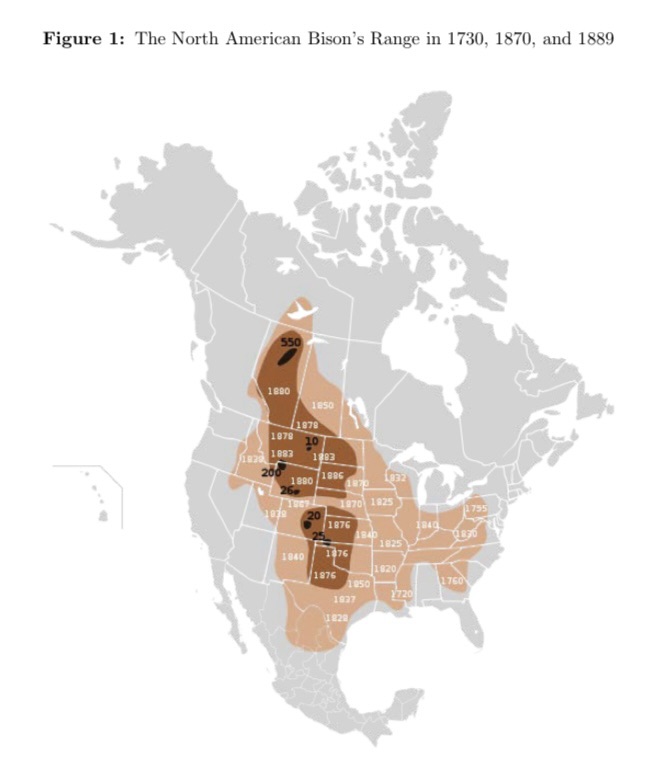
“This is a digitized version of the map generated by Hornaday (1889) illustrating the
range of the North American bison and the timing of its decline. The lightest brown region
is the range as of 1730, the middle region is the range as of 1870, and the final black regions
are the remaining herds (with labelled sizes) as of 1889. The 1889 herds were found in ranched
captivity.”
In this horrifying visual, we see just how drastic the killing of the bison was. From 8 million down to around 800 by the end of the 19th century, the bison were wiped to near extinction. This map, however, doesn’t reflect which tribes were bison-reliant. Some tribes lived in bison-dense areas but relied more on agriculture and trade. So, in their data, they only considered “bison-reliant” tribes to be the ones that lived in the bison-dense areas and had bison as a significant source of consumption. Bison-reliant tribes shared other several distinct characteristics. Firstly, they were either fully nomadic or semi-nomadic, which allowed them to follow the bison herds. Secondly, they had larger populations compared to other tribes, but still were comparable in terms of their lifestyles and self-governance. Lastly, they inhabited less rugged terrain, which would coincide with them following the bison herds.
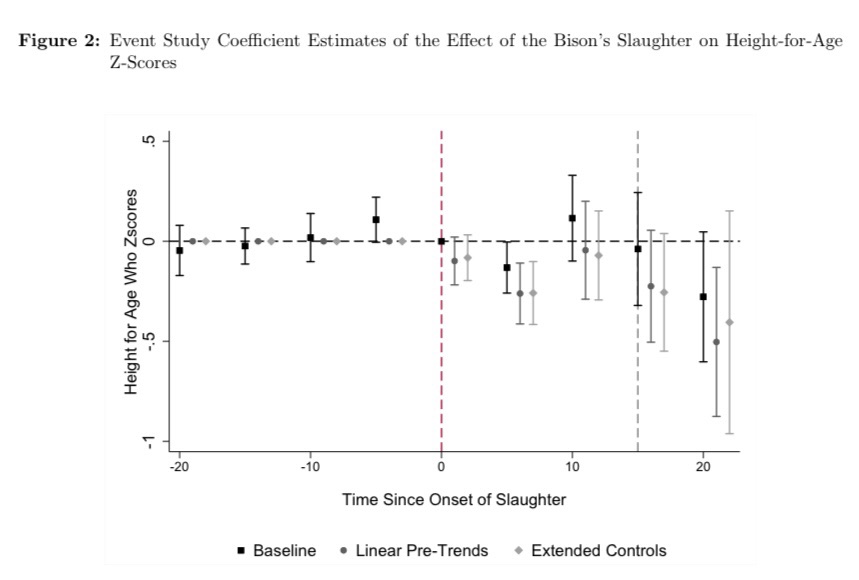
“This figure plots coefficient estimates from event study specifications where the dependent variable is the 2006 World Health Organization’s height-for-age Z-score. Coefficient estimates are presented for five-year birth cohorts with 90% confidence intervals. The dashed red line indicates the start of slaughter (1871), and the gray dashed line indicates the end of feasible bison reliance (1886). All specifications include tribe, age, and cohort fixed effects, as well as a lack of white ancestors indicator. The “linear pre-trends” model conditions on a linear trend for pre-1871 cohorts, while the “extended trends” model includes colonial, cultural, and geographic controls. Date of birth is restricted to after 1850. The main data source is Franz Boas’ 1889 to 1903 sample of Native American stature.”
“Figure 2” describes how the bison-reliant tribes suffered a loss of 2.5 cm in height compared to tribes who weren’t. To show that these changes happened as a consequence of the bison slaughter, they merged their bison-reliant data with data on height, gender, and age of over 15,000 Native Americans collected between 1889 and 1903. Other health effects were found to be higher mortality rates in children, and skewed sex ratios, which they indicated being due to maternal deprivation and depression.
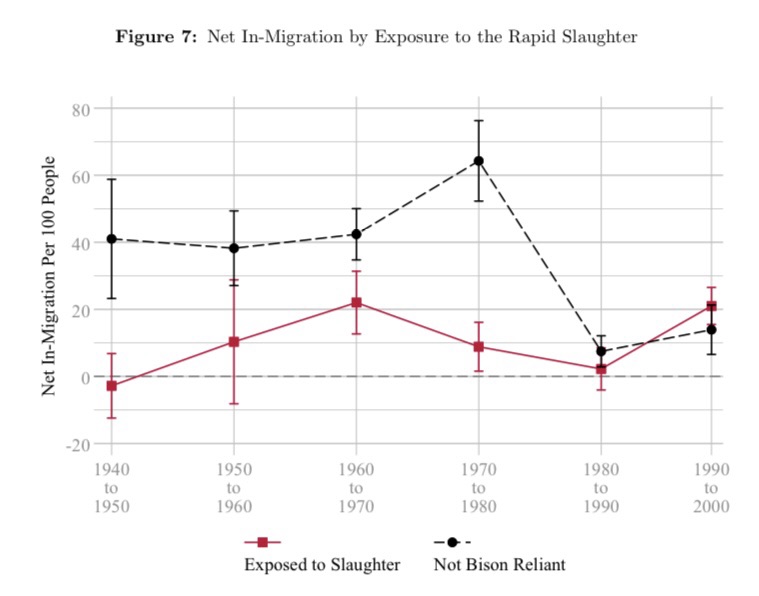
Shown below are figures 3-6. They highlight the per capita incomes (fig. 3), white population and population densities (fig. 4), the number of banks available for nations that were exposed (fig. 5), and employment and capital invested in manufacturing (fig. 6).
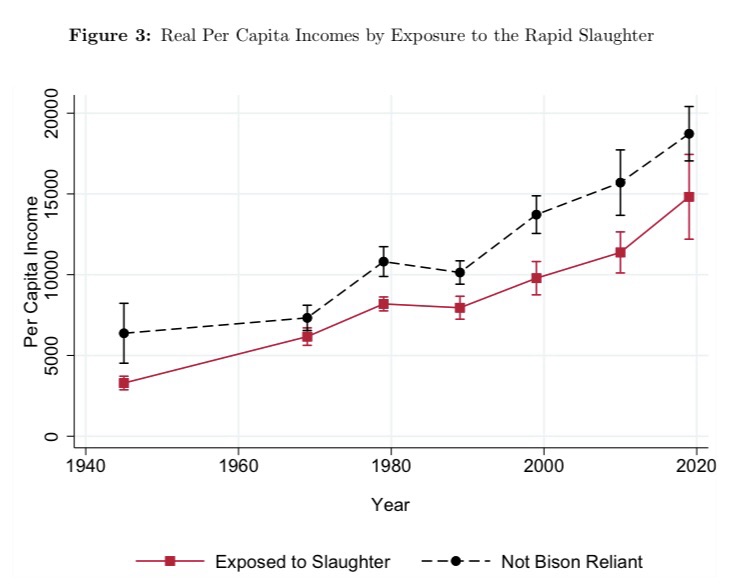
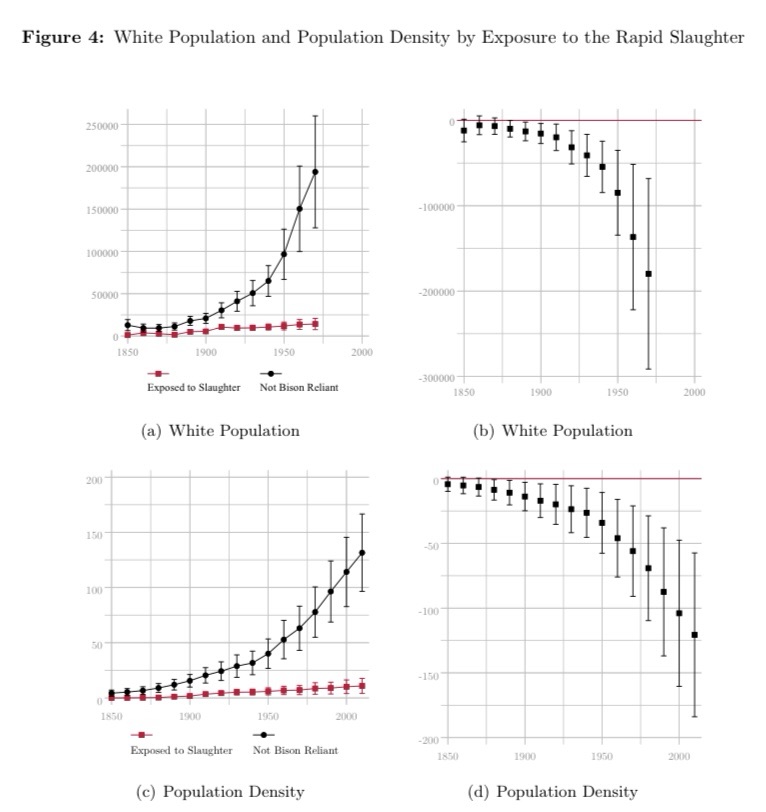
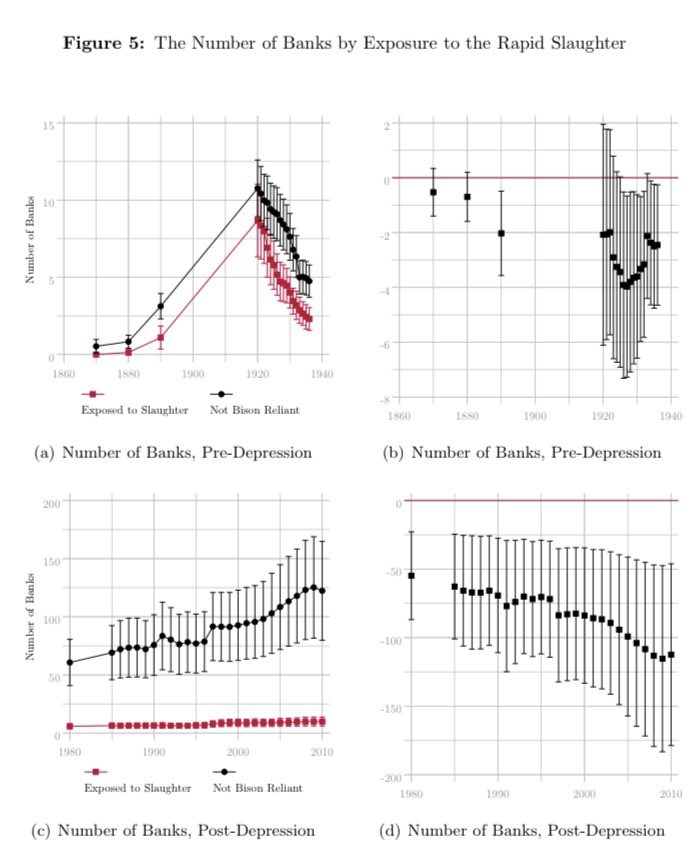
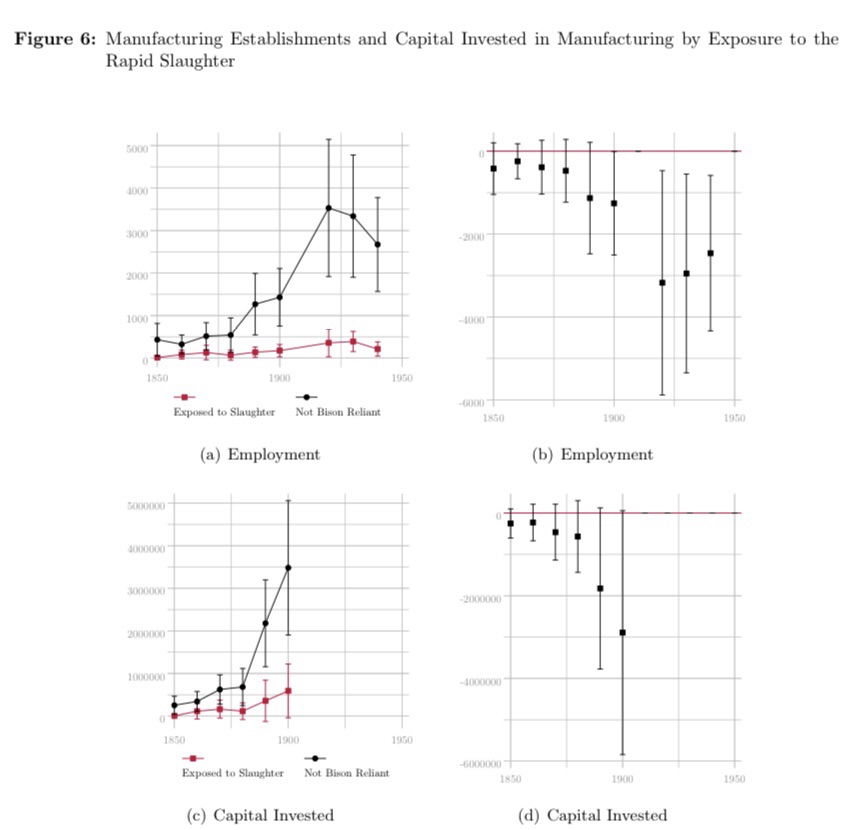
The document does state that the tribes who were bison-dependent and had adequate access to credit were able to adapt through occupational specialization or migration. This was something, however, the tribes not exposed to the slaughter didn’t have to face. With occupational displacement, working-age men in bison-reliant tribes were 26% less likely to report an occupation on the 1900 census.
Heres another paragraph copied and pasted directly from the document.
“Our work contributes to a growing literature that offers a counter-narrative to the colonization of North America. Existing literature suggests that Europeans’ choice to settle brought human capital, technology, and institutions that promoted growth, leading to North America’s wealth. However, Europeans undermined Indigenous institutions, resources, and industries. The reversal of fortunes document provides a novel explanation for the geographic clustering of poverty among Indigenous communities in North America. It contributes to understanding the processes that resulted in the Native American communities of the Great Plains having some of the lowest incomes in the United States.”
Typically, major economic disruptions have shown some degree of recovery over time. For instance, while colonization had a profound impact on Māori communities in New Zealand, subsequent land settlements and cultural revitalization initiatives have contributed to a certain level of restoration. However, this particular shock has left enduring consequences that continue to affect the present.
(Disclaimer: I am not a professional! This is a hobby and passion of mine. All things said here are my strong opinion and are no way intended to make claims or put any one party down.) Thank you for reading!
 Bone & Co.
